

For decades, international education was dominated by a familiar shortlist of destinations. But today, the way students choose where to study is changing.
Students are no longer evaluating destinations based only on prestige or rankings. Affordability, employability, flexibility, global exposure, and long-term career outcomes are becoming equally important in decision-making. (1)
As these priorities evolve, global education is becoming more distributed – creating opportunities for emerging education regions and institutions worldwide.
The Rise of New Education Hubs Is Redefining Study Abroad
One of the biggest shifts in international education is that students are increasingly looking beyond traditional destinations such as the US, UK, and Europe, with Asia emerging as a preferred region for its combination of quality education, affordability, and strong career opportunities.
Recent global student preference studies show that learners increasingly value quality education, affordability, international exposure, career outcomes, and student experience – often in equal measure rather than prioritising one factor alone.
According to educations.com’s international student rankings based on responses from 42,000+ prospective students across more than 200 countries and territories, destination choice is increasingly influenced by:
- Access to globally recognised education
- Employment opportunities
- Culture and lifestyle
- Academic quality
- Personal development opportunities
This reflects a broader movement: students are becoming more intentional and outcome-driven in how they choose international education experiences. (4)
Global Education Is Entering Its Next Growth Phase
Education remains one of the world’s largest and fastest-evolving sectors.
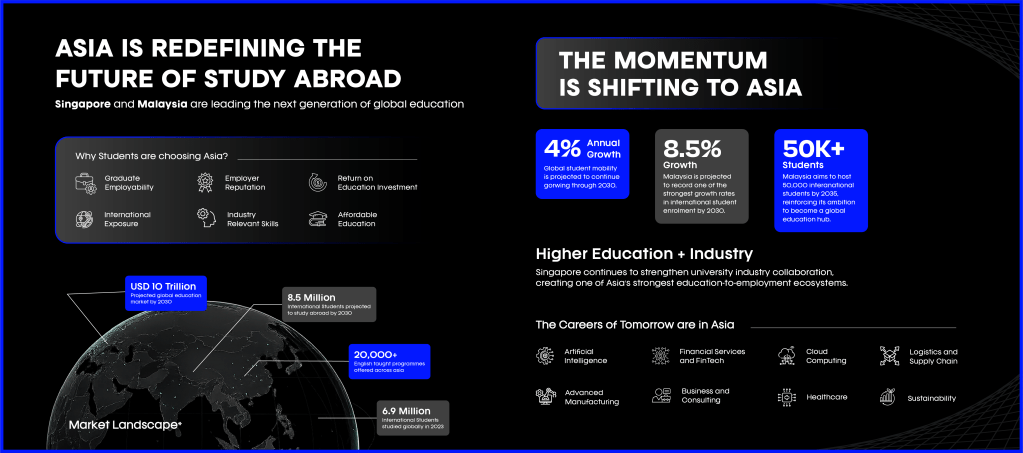
According to the Global Education Market Research Report 2025–2030, the global education market is valued at USD 7.3 trillion in 2025 and is projected to reach USD 10 trillion by 2030, growing at a 6.5% CAGR.
At the same time:
- Digital education is projected to grow from USD 404 billion to USD 850 billion by 2030
- Global learners are expected to increase from 2.8 billion to 3.2 billion
- Online learning penetration is forecast to more than double over the decade
This growth reflects a larger shift: education is becoming more accessible, more international, and increasingly shaped by technology. (2)
International Student Mobility Is Expanding
Study abroad is no longer limited to a handful of traditional destinations.
According to the British Council and Studyportals report, international student mobility reached nearly 6.9 million students in 2023, with demand becoming increasingly diversified across regions.
Students today are exploring:
- Regional education hubs
- International branch campuses
- Flexible delivery models
- English-taught programmes
- Career-oriented qualifications
This marks a transition from a concentrated global education system to a more competitive and multipolar landscape. (1)
Students Are Choosing Outcomes Over Geography
What makes a destination attractive today is changing.
Recent global student preference studies show students increasingly prioritise: (3)
- Career opportunities
- Academic quality
- International exposure
- Lifestyle and culture
- Long-term value of education
This shift explains why emerging education ecosystems are gaining attention.
According to the British Council–Studyportals report:
- Asia alone now offers more than 20,000 English-taught programmes
- Institutions are expanding through transnational education (TNE), international partnerships, and flexible learning models (1)
Students Are Prioritising Value and Return on Education Investment
A major change shaping global mobility is how students evaluate educational decisions.
Traditionally, destination selection was driven by university reputation alone. Today, students are asking:
- What skills will I graduate with?
- What career pathways does this open?
- Does the destination offer international industry exposure?
This evolution reflects a shift from destination-first decision-making to outcome-first decision-making. (4)
| Destination | Estimated Monthly Cost for International Student (excluding tution fee) | Estimated Monthly Cost for International Student (excluding tution fee in INR) | Job Opportunities |
| United Kingdom | £ 1,530 (6) | INR 194,700 | Higher Education improves ROI. Highly saturated. |
| United States | USD830 – 2,080 (7) | INR 79,200–1,98,500 | Highest salaries, but highly competitive. |
| Singapore | SGD750 – 2,000 (8) | INR 55,300–147,600 | Lower competition in many emerging sectors compared to Western markets. |
| Japan | ¥ 90,180 (9) | INR 53,000 | Rapidly growing job market. |
| Malaysia | MYR1,500 – 3,000 (10) | INR 35,000–70,000 | Strong demand in AI, Cloud Computing, Manufacturing, FinTech, Smart Infrastructure and Digital Transformation. |
The Future of Study Abroad Is More Flexible, More Global, and More Outcome-Driven
International education is becoming less about following established paths and more about finding the right fit.
Students are increasingly choosing destinations and institutions that offer:
- International quality
- Career relevance
- Flexible learning pathways
- Global exposure
- Strong value for investment
The future of study abroad may not belong to one region or one model – but to institutions that understand how student expectations are evolving.
Why Singapore and Malaysia Are Gaining Popularity Among International Students
Students increasingly prefer destinations that combine:
- Global learning environments
- Geographic accessibility
- Cultural familiarity
- International mobility opportunities
- Lower transition barriers
According to Asia Exchange’s study abroad outlook, students are showing growing interest in destinations that offer international exposure while remaining connected to regional markets and emerging economic opportunities.
Education ecosystems are becoming more interconnected, allowing students to gain international experience through:
- Cross-border academic pathways
- International partnerships
- Exchange opportunities
- Globally aligned curricula
This trend is making study abroad more accessible to a broader group of students than ever before. (5)
Global Education Choices Are Becoming More Diversified
The study abroad landscape today is significantly more diversified than it was a decade ago.
Students are increasingly building education journeys that combine:
- International qualifications
- Industry exposure
- Skill-based learning
- Career mobility
- Cross-cultural experiences
Rather than focusing on a single “best destination,” students are identifying ecosystems that align with their academic, financial, and professional goals.
This signals a broader evolution of international education – from prestige-led choices to purpose-led choices.
References:
(1) British Council Report
(2) Top 10 Places in Asia to Study Abroad – 2026
(3) Global Education Market Research Report
(4) Top Emerging Study Destinations for Indians in 2026
(5) The Best Places to Study Abroad in 2026
(6) Study in UK
(7) Study IN USA
(8) Ministry of Education- Singapore
(9) Study in Japan
(10) Study in Malaysia