OVERVIEW
Programme Overview
The Professional Certificate in Data Science & AI is designed to equip learners with the skills required to thrive in today’s data-driven economy. As organisations increasingly rely on analytics, machine learning, and artificial intelligence to drive strategic decisions and operational efficiency, this programme aims to provide a strong foundation in Data Science, AI, and ML, thereby intending to enable participants to transform complex data into meaningful, business-ready insights.
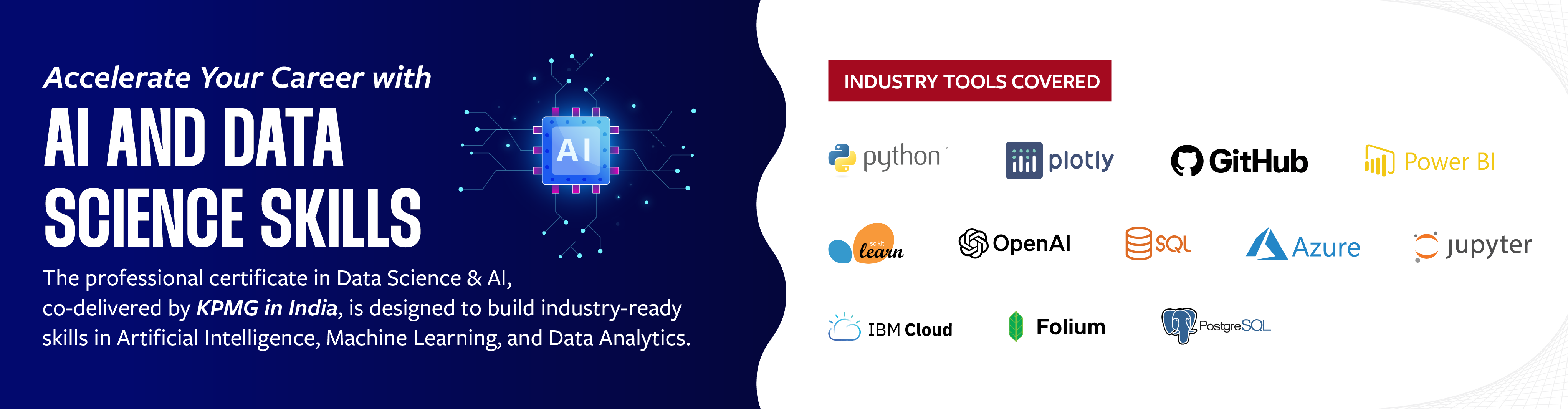
Delivered in a blended weekend format over 6 month, the programme combines live masterclasses, with a 2-day optional intensive bootcamp, hands-on labs, experiential learning, and a mentored capstone project. Learners gain practical exposure to industry-relevant tools such as Python, SQL, Power BI, GitHub, Azure, IBM Cloud, and Scikit-learn, ensuring real-world application of concepts. Upon completion, participants will understand the process of designing, implementing, and optimising AI-powered solutions that enhance decision-making, automate processes, and strengthen organisational competitiveness, and benefit from structured career guidance and mentorship support.

Practical Training
Learn through bootcamps, live sessions, and a mentored capstone using industry tools.

AI & Machine Learning Focus
Build strong skills in data analytics, ML, generative AI, and cloud technologies.

Weekend-only-Learning
Designed for working professionals (a 6 month programme) for career advancement.

Certification &
Support
Preparation for credentials like Certified AI Practitioner with career guidance.
Course Modules And Structure
A programme designed to explore beyond subject knowledge
Phase 1: Core Skills Bootcamp
Core Skills Bootcamp (9 hrs)
This intensive foundation phase aims to prepare learners for the technical modules ahead by strengthening core analytical thinking, digital literacy, and problem-solving skills. Participants are introduced to data fundamentals, Excel basics, structured business thinking, and collaborative tools such as GitHub.
Option 1:
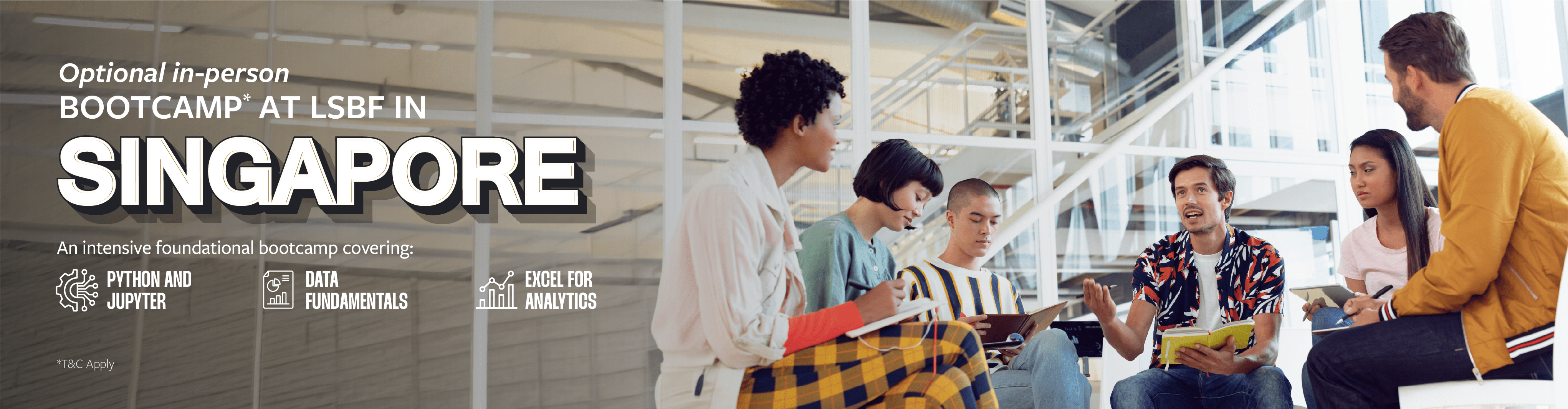
Attend an immersive bootcamp in Singapore
Option 2:
Join the bootcamp live online
Phase 2: Professional Certificate in Data Science & AI
Module 1: Essentials of Data-Driven Business Strategy (9 hrs)
Develop a strong foundation in data-driven business strategy by applying structured analytics frameworks such as CRISP-DM, aligning data insights with business objectives through stakeholder-focused approaches, evaluating data ethics and compliance requirements including AI regulations, and understanding the role, career pathways, and industry relevance of data science as a critical and in-demand field.
Module 2: Applied Python for Data Science and Analytics : Delivered by KPMG in India (16 hrs)
Build practical data science capabilities using Python by mastering core programming concepts such as syntax, data types, variables, and control structures, while leveraging libraries like Pandas, NumPy, Matplotlib, and Seaborn within Jupyter Notebooks to perform exploratory data analysis, clean and transform datasets, handle missing values and outliers, and generate insights through summaries and visualisations, along with accessing and processing data from external sources using REST APIs, web scraping techniques, and GitHub workflows.
Module 3: Mastering SQL and Cloud Data Platforms (12 hrs)
Develop strong data management and querying capabilities by understanding database structures and relationships, effectively executing SQL commands, and building and managing databases through tables, views, joins, and transactions, while applying advanced SQL operations such as filtering, grouping, and data manipulation using built-in functions. Gain practical experience in database security through access control mechanisms, work with cloud data platforms including Microsoft Azure SQL and NoSQL systems, connect cloud databases to Python environments, and apply data modelling techniques using tools like PostgreSQL.
Module 4: Visual Analytics and Data Storytelling (15 hrs)
Create impactful data visualisations and narratives by using Python libraries such as Matplotlib, Seaborn, and Folium to design a wide range of charts – including line, bar, pie, scatter, histogram, and advanced visuals like geospatial maps, waffle charts, and regression plots – while building interactive dashboards with tools like Plotly and Dash, and effectively translating data insights into clear, engaging stories through data storytelling and real-world case studies.
Module 5: AI & Machine Learning for Business Leaders : Delivered by KPMG in India (20 hrs)
Apply core machine learning techniques such as linear and logistic regression, k-NN, decision trees, and clustering for both supervised and unsupervised learning, while leveraging the Scikit-learn workflow to develop, evaluate, and optimise predictive models on real-world datasets, perform model tuning using appropriate metrics and validation strategies, and build end-to-end machine learning solutions through hands-on labs, projects, and practical applications.
Module 6: AI-Powered Decision Making: Prompt Engineering (12 hrs)
Develop capabilities in AI-powered decision-making by understanding the fundamentals of generative AI and large language models, including platforms like ChatGPT, Watsonx, and Azure OpenAI, while building practical prompt engineering skills for analytics, coding, and data preparation, applying AI techniques to generate and refine datasets, leveraging real-world business use cases to enhance workflows and strategic insights, and addressing ethical considerations, hallucination risks, and explainability challenges in AI applications.
Assessment: Capstone Project (3 hrs)
The capstone project is designed to provide learners with an opportunity to apply their data science and AI skills in a practical, real-world context. Participants will work on an end-to-end project that involves data collection, cleaning, analysis, and the development of machine learning models to solve business problems. The project emphasises the use of industry-relevant tools and techniques, enabling learners to generate actionable insights, build predictive solutions, and effectively present their findings, demonstrating their readiness for data-driven roles in the industry.
what to expect
Possible Learning & Career Outcomes
Learning Outcomes
- Apply Excel, Python, and GitHub to perform structured data analysis tasks.
- Use business analytics frameworks such as CRISP-DM to solve real-world problems within ethical and regulatory boundaries.
- Write and execute Python programs using Pandas, NumPy, Matplotlib, and Seaborn for data cleaning, transformation, and visualisation.
- Design, query, and integrate SQL databases and cloud-based data solutions into analytical workflows.
- Develop interactive dashboards and compelling visual narratives for business stakeholders.
- Implement and evaluate machine learning models including regression, classification, and clustering.
- Apply generative AI tools and prompt engineering techniques responsibly to automate analytics and enhance decision-making.
- Translate analytical and predictive insights into strategic, data-driven business recommendations.
Career Outcomes
- Unlock roles such as Data Analyst, Business Analyst, Data Scientist, and AI/ML Specialist
- Build the ability to analyse complex datasets and generate actionable business insights
- Gain practical experience in Python, SQL, data visualisation, and machine learning workflows
- Develop skills to design and deploy AI-powered solutions for real-world business problems
- Work with modern tools like Power BI, Azure, IBM Cloud, and Scikit-learn
- Position yourself for opportunities across analytics, consulting, technology, and data-driven industries
Note: KPMG in India does not provide internships or placement guarantees, internships and placements exist solely under the purview of LSBF
KPMG in India is solely an Academic Partner
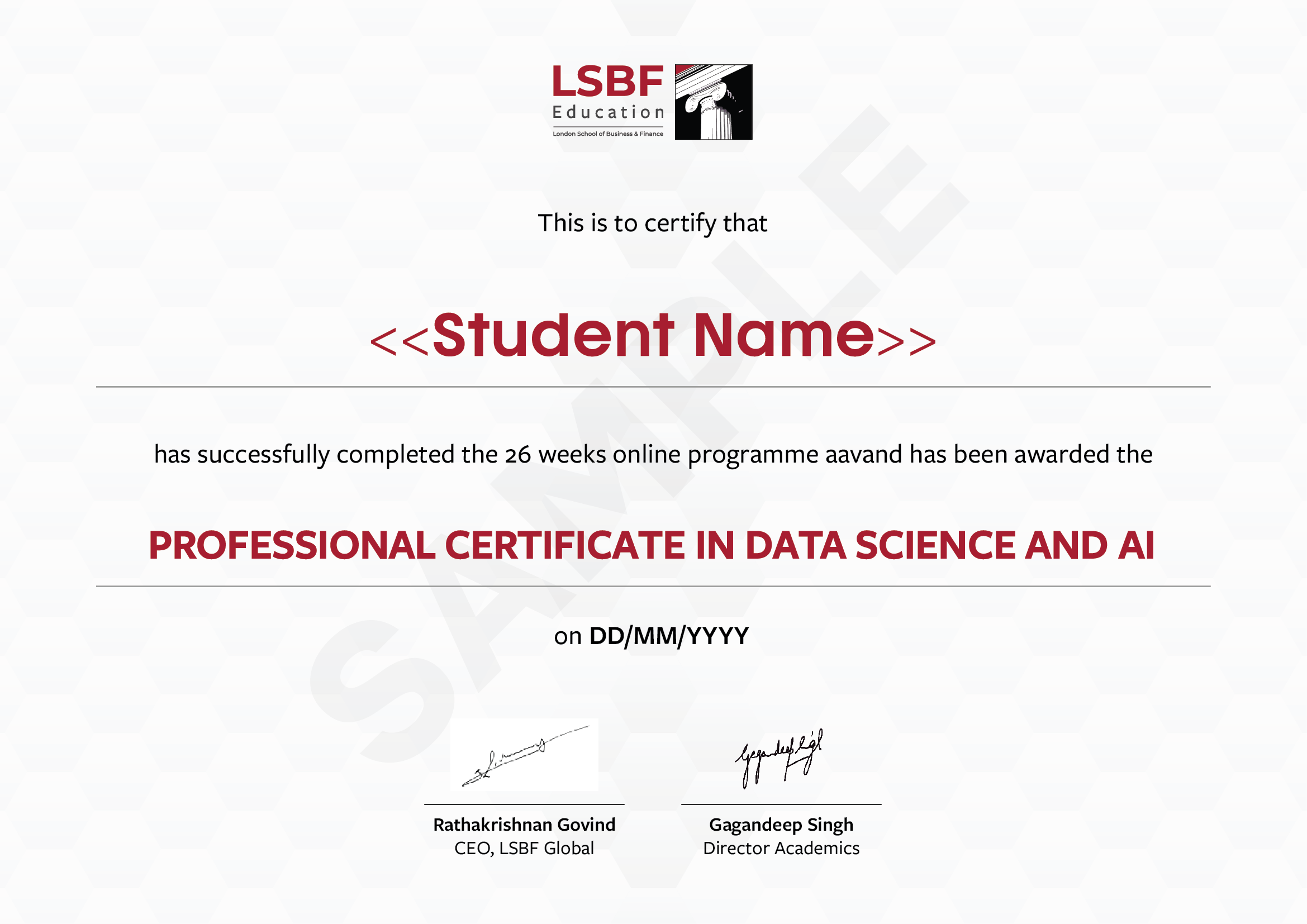
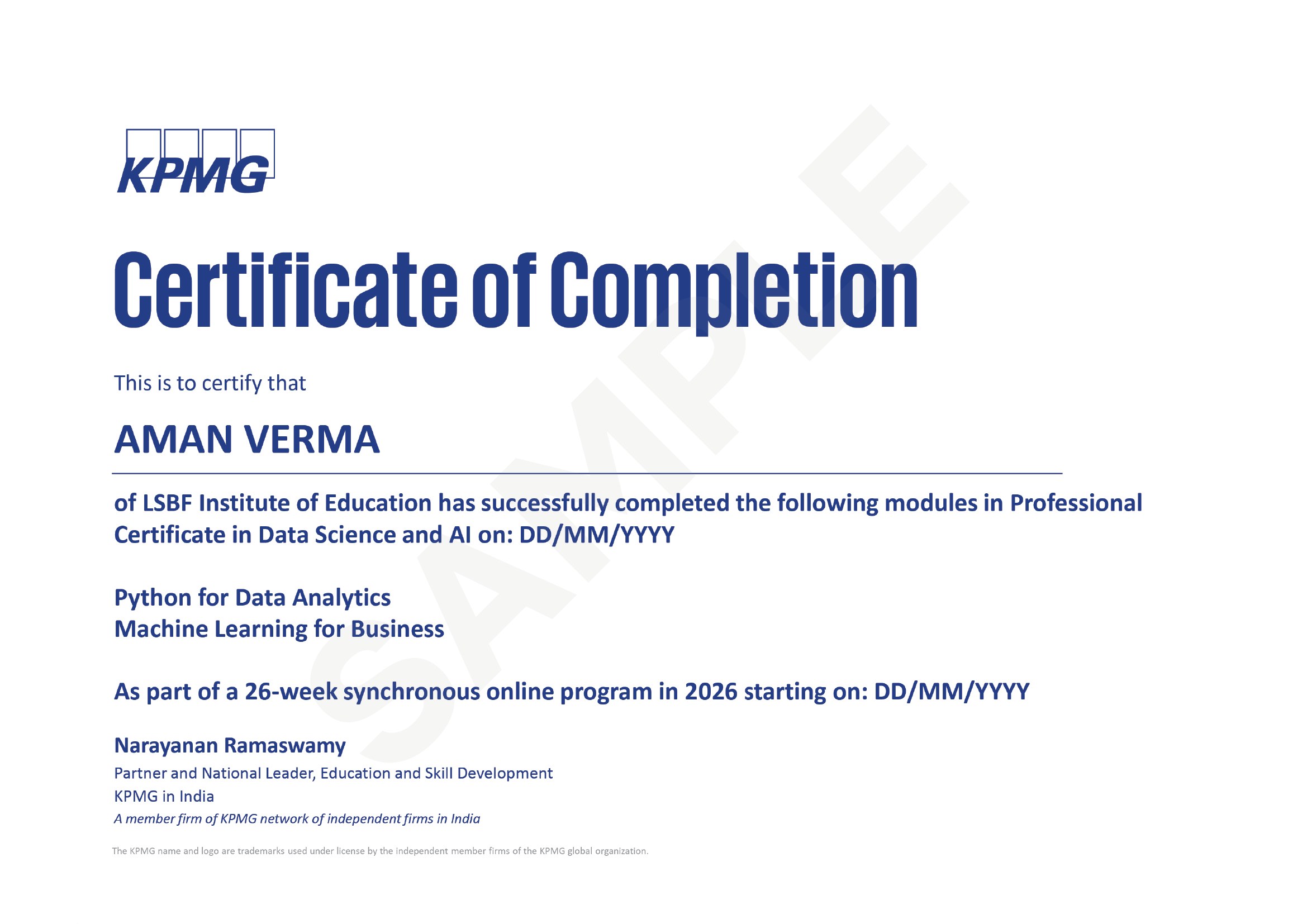
dual certification by lsbf & kpmg in india
FEES (Exclusive of gst)
₹2,00,000 (+18% GST)
ESSENTIAL
Self Paced Learning
INR 50,000 + 18% GST
Certificate from LSBF Education
PROFESSIONAL
Live Instructor-Led Learning
INR 1,00,000 + 18% GST
Certificate from LSBF Education and KPMG in India
GLOBAL
Live Learning + Singapore Immersion
INR 1,50,000* + 18% GST
Certificate from LSBF Education and KPMG in India

Alvin Yeo
Singapore Campus FacultyPart-time Lecturer, School of Advanced Technology & Digital Media


Dr Preethi Kesavan
Singapore Campus FacultyDirector of Studies and Head, School of Advanced Technology & Digital Media




HOW TO APPLY?
Indian students applying for programmes at LSBF India are required to complete the prescribed admission formalities in accordance with the programme requirements. Prospective applicants may submit an enquiry through our official application channels or connect directly with our admissions team for personalised guidance on programme selection, eligibility criteria, documentation, and next steps.
Our dedicated team is committed to supporting you at every stage of your journey, from application submission to final enrolment- ensuring a smooth and seamless admissions experience.
Admission Process for Professional Certificate Programmes
LSBF India’s Professional Certificate Programmes are designed to equip learners with industry-relevant skills and practical knowledge that align with current market demands. These focused courses combine academic rigour with real-world application, enabling working professionals and aspiring specialists to strengthen their expertise, enhance employability, and stay competitive in a rapidly evolving business environment.
Online Application
Applicants are required to complete the online application form available on our official website. All mandatory fields must be filled in accurately, and relevant academic or professional documents should be uploaded where required to ensure a smooth review process.
Application Evaluation
Once submitted, the programme team will carefully assess the candidate’s academic background, professional experience (if applicable), and eligibility criteria to ensure alignment with the selected programme.
Offer of Enrolment
Candidates who meet the entry requirements will receive an official Offer of Enrolment outlining the programme details, fee structure, and next steps for confirmation.
Fee Payment & Confirmation
Upon acceptance of the offer, candidates are required to complete the programme fee payment within the stipulated timeline to confirm their enrolment and secure their seat.