

India’s digital economy is expanding at an unprecedented pace. From banking and healthcare to manufacturing, retail and government services, organisations are increasingly relying on cloud technologies, artificial intelligence (AI), connected devices and digital platforms to deliver services and drive growth.
While this digital transformation creates enormous opportunities, it also increases exposure to cyber threats. As a result, cybersecurity has evolved from being an IT function to becoming a strategic business priority.
For graduates, working professionals and career switchers, this presents a significant career opportunity. However, employers are not simply looking for more applicants; they are looking for professionals who possess practical, industry-relevant skills to protect modern digital businesses.
Why is demand for Cybersecurity professionals growing?
As organisations become more connected, every digital interaction creates new security challenges. Online payments, cloud applications, remote work, digital healthcare, e-commerce and AI-powered business processes all depend on secure digital infrastructure.
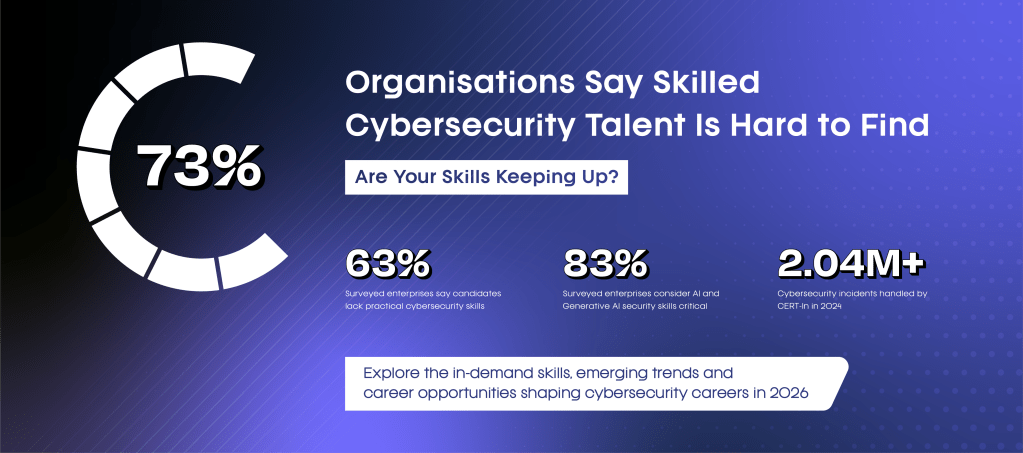
The scale of this challenge continues to grow. According to the CERT-In Annual Report 2024, more than 2.04 million cybersecurity incidents were handled during the year, highlighting the increasing frequency and sophistication of cyber threats across sectors.
Today’s organisations need professionals who understand how to protect cloud environments, secure digital identities, manage cyber risks, safeguard sensitive information and respond effectively when incidents occur. Cybersecurity is no longer just about antivirus software or password management; it is about enabling business resilience in an increasingly digital world.
Cybersecurity trends shaping careers in 2026
The cybersecurity landscape continues to evolve rapidly, creating demand for professionals with specialised capabilities.
Artificial Intelligence is reshaping cybersecurity
Artificial intelligence is transforming both cyber defence and cybercrime. Threat actors are using generative AI to automate phishing campaigns, create convincing impersonations and accelerate reconnaissance. At the same time, security teams are leveraging AI to detect anomalies, automate investigations and strengthen incident response.
As AI adoption accelerates, organisations increasingly require professionals who understand both cybersecurity principles and AI-enabled security operations.
Cloud Security is becoming business critical
Most organisations now operate across hybrid and cloud environments. Protecting cloud infrastructure, applications and digital identities has therefore become a strategic priority.
Professionals with expertise in cloud security, identity and access management (IAM), governance and compliance are expected to remain in high demand across industries.
Cybersecurity is becoming multidisciplinary
Modern cybersecurity professionals need to understand technology, risk, compliance and business operations. Some of the fastest-growing areas include:
- Zero Trust Security
- Cloud Security
- Identity and Access Management (IAM)
- Application and API Security
- Governance, Risk and Compliance (GRC)
- Data Privacy and Regulatory Compliance
- Digital Forensics and Incident Response
- Operational Technology (OT) Security
- AI Security
These developments are creating diverse career pathways for professionals with both technical and analytical capabilities.
India’s Cybersecurity talent gap is a skills gap
India’s challenge is not simply a shortage of cybersecurity professionals; it is a shortage of professionals with practical, job-ready capabilities.
According to the DSCI–SANS Indian Cyber Security Skilling Landscape Report 2026:
- 73% of surveyed enterprises reported limited availability of skilled cybersecurity professionals.
- 63% identified insufficient practical skills among applicants.
- 83% considered AI and Generative AI security skills critical for future cybersecurity teams.
These findings highlight an important shift in employer expectations. Organisations are increasingly looking beyond academic qualifications to assess whether candidates can apply cybersecurity concepts in real-world environments.
Employers value professionals who can investigate alerts, assess vulnerabilities, secure enterprise systems, communicate cyber risks and recommend practical solutions.
Cybersecurity jobs in demand in India
Cybersecurity now offers career opportunities across multiple industries, including banking, consulting, healthcare, manufacturing, e-commerce, telecommunications and technology services.
Some of the most sought-after roles include:
- Security Operations Centre (SOC) Analyst
- Cybersecurity Analyst
- Threat Intelligence Analyst
- Cloud Security Specialist
- Application Security Professional
- Governance, Risk and Compliance (GRC) Analyst
- Digital Forensics and Incident Response Specialist
- Security Architect
- AI Security Engineer
As organisations continue investing in digital transformation and cloud technologies, demand for professionals across these roles is expected to remain strong.
How to prepare for a Cybersecurity career
A successful cybersecurity career begins with strong technical foundations and continuous learning.
Start by developing an understanding of:
- Networking fundamentals
- Operating systems
- Cloud computing
- Cybersecurity principles
- Identity and Access Management
- Governance and Risk Management
Once these foundations are established, professionals can specialise in areas such as cloud security, digital forensics, governance and compliance, threat intelligence or AI security.
Practical learning is equally important. Hands-on labs, simulations, real-world case studies and capstone projects help bridge the gap between understanding cybersecurity concepts and applying them in enterprise environments.
Strong communication, analytical thinking and problem-solving skills are also increasingly valued, as cybersecurity professionals frequently collaborate with business leaders, technology teams and external stakeholders.
Build Practical Cybersecurity Capabilities with LSBF India

For professionals looking to build industry-relevant cybersecurity skills, the LSBF India Professional Certificate in Cyber Security offers a structured pathway to practical learning.
Delivered in a flexible live-online weekend format, the six-month programme combines expert-led learning with hands-on exercises, real-world case studies and a mentored capstone project. Select modules are co-delivered with KPMG in India, providing learners with exposure to contemporary enterprise cybersecurity practices.
The programme covers enterprise security, cloud security, governance and compliance, security administration and practical cybersecurity tools, helping learners develop capabilities aligned with today’s evolving digital workplace.
If you are planning your next career move in cybersecurity, building practical, employer-relevant skills can help you stand out in an increasingly competitive market.