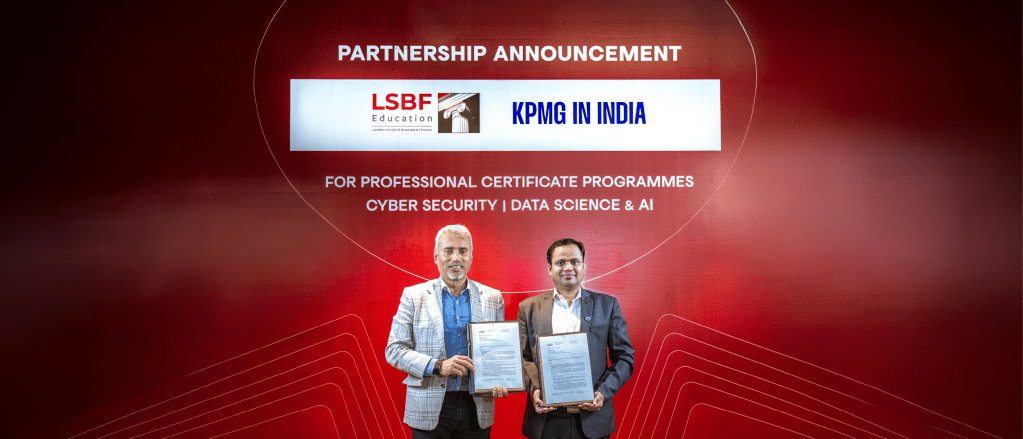
LSBF has announced that it has engaged KPMG in India for the delivery of select modules in two of its Professional Certificate programmes, the Professional Certificate in Data Analytics & AI and the Professional Certificate in Cyber Security.
The programmes are designed in such a manner that the participants gain industry insights, receive opportunities for interaction with KPMG in India professionals, and get exposure to real-world scenarios that reflect the complexity of today’s data and cybersecurity landscape. Participants may also benefit from practical perspectives through instructor-led sessions, case-based discussions, and illustrative examples aligned to industry practices.
The curriculum aims to provide learners with a broader understanding of current trends, tools, and frameworks commonly used in the field. Additionally, the programmes are structured to support conceptual clarity and applied learning through guided exercises and interactive formats.
India continues to witness growing demand for skilled professionals in AI, data analytics and cyber security, alongside increasing cyber risks and digital transformation across industries. Through this initiative the participants will gain exposure to industry perspectives, practical applications, and contemporary tools and frameworks that are shaping the future of technology and business.
Professional Certificate in Data Analytics & AI is a six-month weekend programme covering Python, SQL, Machine Learning, Power BI, Cloud Platforms, Generative AI, Prompt Engineering, and AI Ethics, including a mentored capstone project designed around practical business applications. Learners will be provided with opportunities to gain hands-on exposure to industry-relevant tools and technologies, thereby helping them build practical skills in data analytics, artificial intelligence, and business decision-making.
The Professional Certificate in Cyber Security is a six-month weekend programme covering cyber risk management, enterprise security frameworks, governance, risk and compliance, threat detection and mitigation strategies, digital forensics, vulnerability assessment, and emerging cybersecurity challenges. The course is designed to help professionals strengthen their understanding of cyber risk management, enterprise security frameworks, threat mitigation strategies, and evolving digital security challenges in modern organisations. Learners will get opportunities to gain hands-on exposure to industry-relevant tools such as Wireshark, Nmap, Metasploit, Wazuh, OpenVAS, and Python, helping them build practical skills for digital security environments*.
Both programmes are delivered in a live online weekend learning format, making them accessible for working professionals across India.
Rathakrishnan Govind, Chief Executive Officer, LSBF Global, said, “Initiatives like our collaboration with KPMG in India help bridge the gap between academic certification and real-world employability. Our vision is simple yet profound: to make world-class education truly borderless. From Singapore to Kuala Lumpur, and from Shanghai to India, LSBF is building a global learning institution that meets ambitious professionals wherever they are through programmes, partnerships, and pathways that open doors worldwide. India’s employers are looking beyond degrees; they want professionals who can step in on day one and make an impact. By integrating KPMG’s industry expertise into our curriculum, we are strengthening the connection between academic learning and real-world business application. This is what future-ready education looks like.”
Narayanan Ramaswamy, Partner and National Leader, Education and Skill Development, KPMG in India, said, “India’s digital economy is evolving rapidly, increasing the need for skilled professionals in data science, AI, and cybersecurity. Our collaboration with LSBF India reflects a shared commitment towards enabling industry-aligned learning experiences that help professionals build relevant and future-ready capabilities. Together, we aim to support professionals in strengthening their technical expertise and enhancing their ability to navigate evolving business and technology landscapes.”