

The workplace is changing faster than many job descriptions can keep up.
Artificial intelligence is becoming part of everyday work. Industries are adopting new technologies and operating models. Roles are evolving, and the skills required to perform them are changing alongside them.
According to the World Economic Forum’s Future of Jobs Report 2025, employers expect 39% of workers’ core skills to change by 2030.
For students and professionals, this raises an important question:
What does it actually mean to be workplace-ready in 2026?
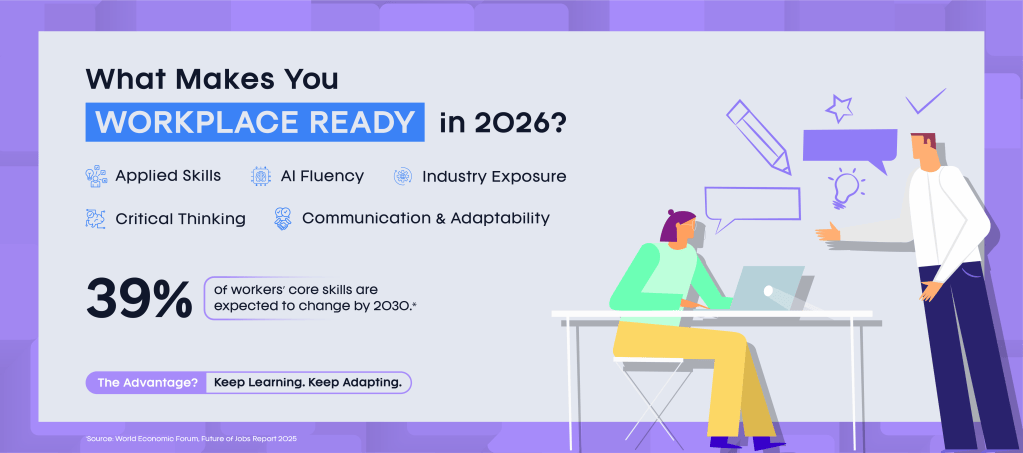
A qualification remains an important foundation. But increasingly, career readiness is also about the ability to apply knowledge, work with emerging technologies, understand industry, think critically and adapt as the workplace evolves.
Here are five capabilities shaping workplace readiness today.
1. Applied Skills: Turning Knowledge Into Action
Knowing something and knowing how to use it are different capabilities.
Employers operate in environments where problems rarely arrive as textbook questions. Professionals need to interpret information, assess situations, make decisions and translate their knowledge into action.
That is why practical learning is becoming increasingly important.
Projects, case studies, simulations, practical assignments and capstones can help learners move beyond understanding concepts to applying them in realistic contexts.
For learners, the question is increasingly not only “What do I know?” but also “What can I do with what I know?”
That distinction sits at the heart of workplace readiness.
2. AI Fluency: Learning to Work With Technology
AI is no longer relevant only to technology professionals.
It is increasingly influencing how people research, analyse information, create content, automate processes, serve customers and make decisions across business functions.
The World Economic Forum identifies AI and big data among the fastest-growing skills through 2030.
But workplace AI fluency is about more than knowing how to use a particular tool.
Professionals need to understand how AI can improve their work, how to evaluate its outputs and when human judgement is required. They also need to recognise issues surrounding accuracy, privacy, ethics and responsible use.
The emerging advantage is therefore not simply knowing about AI.
It is knowing how to work effectively with it.
3. Industry Exposure: Understanding the World Beyond the Classroom
Industries do not stand still.
New technologies emerge. Regulations change. Customer expectations evolve. Business models are disrupted. Skills that were highly valuable a few years ago may need to be complemented by entirely new capabilities.
Workplace readiness therefore requires more than disciplinary knowledge. It also requires an understanding of the environment in which that knowledge will be applied.
Industry-led masterclasses, practitioner perspectives, live cases, professional networks and exposure to real business challenges can help learners understand how their field is evolving.
This context matters because employers are not simply recruiting for what organisations need today. They are also preparing for what they may need next.
4. Critical Thinking: Making Sense of More Information
Access to information has never been easier.
Making sense of it is becoming harder.
As AI makes it possible to generate answers, analysis and content almost instantly, the ability to question information, identify assumptions, evaluate evidence and make informed decisions becomes increasingly valuable.
The World Economic Forum continues to identify analytical thinking as the most sought-after core skill among employers.
This points to an important shift.
Technology can accelerate access to information. But professionals still need to determine what information matters, whether it can be trusted and how it should inform a decision.
In an AI-enabled workplace, critical thinking does not become less important.
It becomes more important.
5. Communication and Adaptability: The Human Capabilities That Endure
Technology may transform how work gets done, but organisations are still built around people working with other people.
Professionals need to explain ideas clearly, collaborate across functions, understand different perspectives, respond to feedback and communicate decisions effectively.
At the same time, they need to adapt.
The significance of the World Economic Forum’s 39% skills-change forecast is not simply that workers will need new skills. It is that learning itself is becoming an ongoing professional capability.
The workplace-ready professional of 2026 therefore cannot be defined by a fixed set of skills acquired at the beginning of a career.
Career readiness increasingly means being prepared to learn, unlearn and continue developing as work changes.
From Qualification to Capability
The future of employability is not a choice between qualifications and skills.
It is about bringing them together.
Academic learning provides the foundation. Applied experiences help translate that knowledge into capability. Industry exposure creates context. AI fluency prepares learners for emerging ways of working. Human capabilities help professionals navigate complexity and change.
Together, they create a more complete picture of workplace readiness.
At LSBF, this thinking informs an approach to education centred on industry relevance, AI-integrated learning and employability helping learners connect what they learn with how knowledge is applied in the world of work.
Because in a workplace that will continue to change, career readiness cannot be measured only by what you know today.
It is also defined by your ability to apply, adapt and keep learning.