

Cybersecurity is no longer limited to a small group of highly specialised technology professionals. As organisations expand their use of cloud platforms, digital applications and connected environments, cybersecurity has become an essential part of how businesses operate.
For someone considering a career in the field, however, knowing where to begin can be challenging. Cybersecurity covers a wide range of disciplines, from security operations and cloud security to governance, risk and compliance, digital forensics and incident response.
The good news is that you do not need to master everything at once. A strong cybersecurity career starts with the right foundations, followed by practical experience and continuous learning.
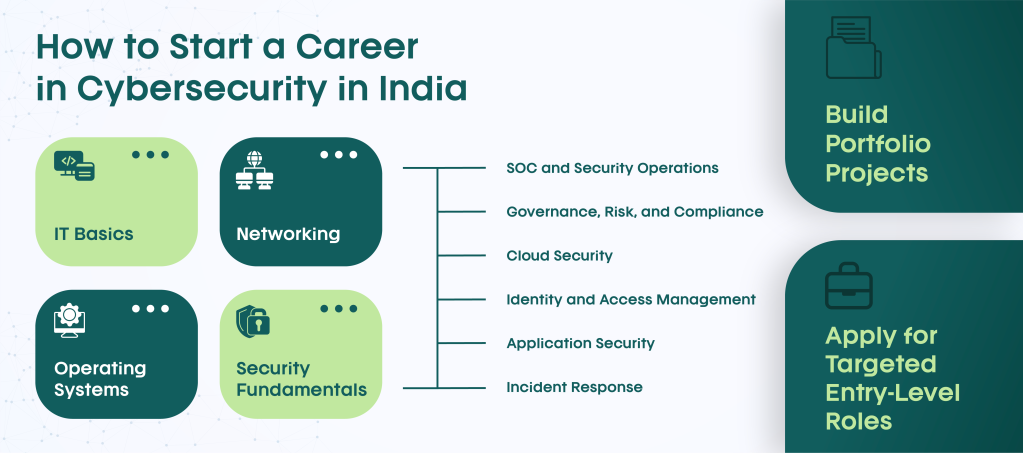
Start with the Fundamentals
Before choosing a specialisation, understand how the technology you want to protect actually works.
Begin with networking, operating systems and cybersecurity fundamentals. Learn how networks communicate, how users and systems are authenticated, how vulnerabilities arise and how security controls help reduce risk.
You should also develop an understanding of:
- Network security and common protocols
- Windows and Linux environments
- Authentication and access controls
- Vulnerabilities and threat management
- Data protection and privacy
- Basic cloud security
- Risk management and incident response
These fundamentals provide the foundation for more specialised cybersecurity learning.
Do You Need Coding to Enter Cybersecurity?
Not necessarily.
Cybersecurity has multiple career pathways, and they do not all require advanced programming. Roles in governance, risk and compliance, security operations and certain areas of security management may place greater emphasis on analysis, investigation, documentation, and risk assessment.
At the same time, basic scripting can be valuable. Python, Bash, or PowerShell can help professionals automate repetitive tasks, analyse information, and work more efficiently.
The objective is not to become a software developer. It is to understand enough technology to solve security problems effectively.
Choose a Cybersecurity Career Path
Once you have established your foundation, explore the areas that align with your interests and strengths.
Security Operations: Monitor security events, investigate alerts, and support incident responses.
Cloud Security: Help protect cloud infrastructure, applications, and data.
Identity & Access Management: Manage authentication, authorisation and access to organisational systems.
Governance, Risk & Compliance: Work with security policies, risk management, controls and regulatory requirements.
Application Security: Identify and address vulnerabilities in software and applications.
Digital Forensics & Incident Response: Investigate security incidents and analyse what happened.
Security Architecture: Design systems and security controls with protection built into the environment.
There is no single route into cybersecurity. Your pathway can evolve as your experience and interests develop.
Build Practical Cybersecurity Experience
Understanding cybersecurity concepts is only the beginning. Applying them is what helps turn knowledge into capability.
The Indian Cyber Security Skilling Landscape Report 2025–26, published by DSCI and SANS Institute, found that 63% of enterprises reported limited hands-on practical skills among job candidates.
For aspiring professionals, this makes practical learning important.
Work through authorised labs and simulations. Practise analysing security logs, assessing vulnerabilities, configuring access controls and responding to simulated incidents. Build projects and document your approach, findings and recommendations.
A strong portfolio should demonstrate not simply which tools you have used, but how you think through a security problem.
Do You Need a Degree or Certification?
There is no single qualification that guarantees a cybersecurity career.
A degree can provide broad academic foundations, while certifications can demonstrate knowledge in specific areas. Structured professional programmes can bring these elements together with expert instruction, practical exercises, and applied projects.
What matters is building a combination of knowledge, practical capability, and the ability to keep learning as cybersecurity continues to evolve.
Build Your Cybersecurity Capabilities with LSBF India
For learners looking for a structured pathway, the LSBF India Professional Certificate in Cyber Security combines expert-led learning with practical application.
The six-month, weekend-only programme covers security design and architecture, cloud security architecture and compliance, security administration, cybersecurity regulatory compliance in India and career growth strategies. Learners also complete a mentored capstone project focused on designing an end-to-end security solution.
Select modules are delivered by KPMG in India, giving learners exposure to industry perspectives and practical cybersecurity scenarios.
For anyone starting their cybersecurity journey, the most important first step is not trying to learn everything.
It is building the right foundation, gaining practical experience and developing the capabilities to keep pace with an evolving digital environment.